
Post-apocalyptic Naturalism, the Road, and the Last of Us

Back in October I snuck into a Symposium on American Literary Naturalism and the Visual/Digital held in UCC, excited by a glimpse of academic Video Game discussion. On that day the 13th, Sarah McCreedy discussed New Naturalism and Video Games, with a particular focus on Naughty Dog’s 2013 post-apocalyptic action adventure The Last of Us.

She argued that though less discussed, video games such as The Last of Us engage with a new kind of naturalism. This new naturalism updates conceptions of determinism, instead highlighting the illusion of free will under neoliberal capitalism.

The Last of Us depicts a type of quint-essential American story, a journey across America that is ultimately fruitless. In the process, it features moments of beauty and nature. It also emphasises an intent of being grounded and realistic, honing in on resource allocation and scarcity among other features. As such, it resembles other American works of Naturalism. I myself recently read Cormac McCarthy’s The Road, a novel to which The Last of Us closely relates. Both works track a journey across a changed American landscape, a landscape that inspires awe both in negative and positive senses.

Sarah McCreedy’s conception of The Last of Us as an updated type of Naturalistic story explores media interaction and its fascinating impact. Video games engage in a dance of interactivity with their player. There is a relationship between player, game, and character that implies choice for the player, a power to shape their own, personal experience. This idea of Free Will turns out to be deceptive, McCreedy argued, as the linearity of the plot comes to light. The player cannot impact the choices Joel, the game’s protagonist, makes in cut scenes and vital plot moments. I find this observation interesting for its awareness of medium. The Last of Us and The Road share a lot of similarities. However the idea that the themes and messages of these stories transforms due to the ways Readers/Players experience the respective text spawns fascinating questions. Maybe The Road does create a sense of determinism through its introduction of slowly creeping threats and the passivity the reader holds as, for example, the protagonist’s deadly sickness develops. The Last of Us threads the player and Joel together, but the player is alienated from Joel in the most crucial ending moments, rupturing the player’s conception of choice. That kind of illusion of Free Will and deceptive personalised experience permeates a lot more Video Games than The Last of Us. Does this make Video Games an art form suitable to thrive in Neo Liberal Capitalism?

I could write about the latter question at length. Many Role Playing Games, Action-Adventure Games, and Shooters offer moral choices and customisation of character to differing degrees. But since the programming of the game must be realisable, the large scale impact of these choices often only goes so far as a few different endings to achieve. One of my favourite game series, the Bioshock Series, tackles questions of Free Will by denying the player significant choice and impact. The first game in particular weaves the player’s lack of free will into its plot, accompanying a critique of libertarianism and exploitative capitalist structures.
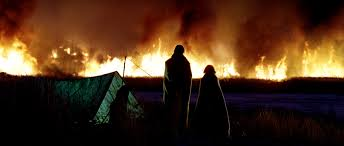
From the film The Road(2009)

Yet, the note on which I want to conclude is different. Honouring the Naturalistic work’s focus on nature, there is an additional argument I would venture to make. The Road and The Last of Us are both works of the post-apocalypse, of the transformed environment and natural space. Their different approaches to choice and the illusion of free will are present in their approaches to post-apocalyptic space. Both perpetuate a conception of lack of human agency and choice in worlds which have been taken away from human authority. Both texts further engage with the threat of human extinction. Meanwhile, nature has reclaimed and eroded human buildings and landscapes. In The Road, the conquering of mankind by the dead world around them is deterministic, and uncontested. People may struggle against each other, but they can only run away from the snow, darkness, earthquakes and fires.

Infected from The Last of Us

As Zombie media, The Last of Us provides undead enemies which the player fights as well as other humans. The virus that creates the undead, a fungi, links them to nature. They look no longer human, appearing overgrown. Through them, the player is given agents of the transformed natural space to combat. As a result, the game provides an illusion of ability to fight the post-apocalyptic natural space, unlike The Road. It is a miming of human agency that turns out to be as deceitful as the game’s Free Will, as the quest to find a cure dissolves.

Applying the paper’s argument to space reveals a core aspect of the post-apocalyptic genre. Agency, human systems, and the Natural link between each other to reveal multitudes of causality and effect. Naturalism, new or old, forms but only one approach to our place in a transformed world.
Reflecting on Textualities 2023

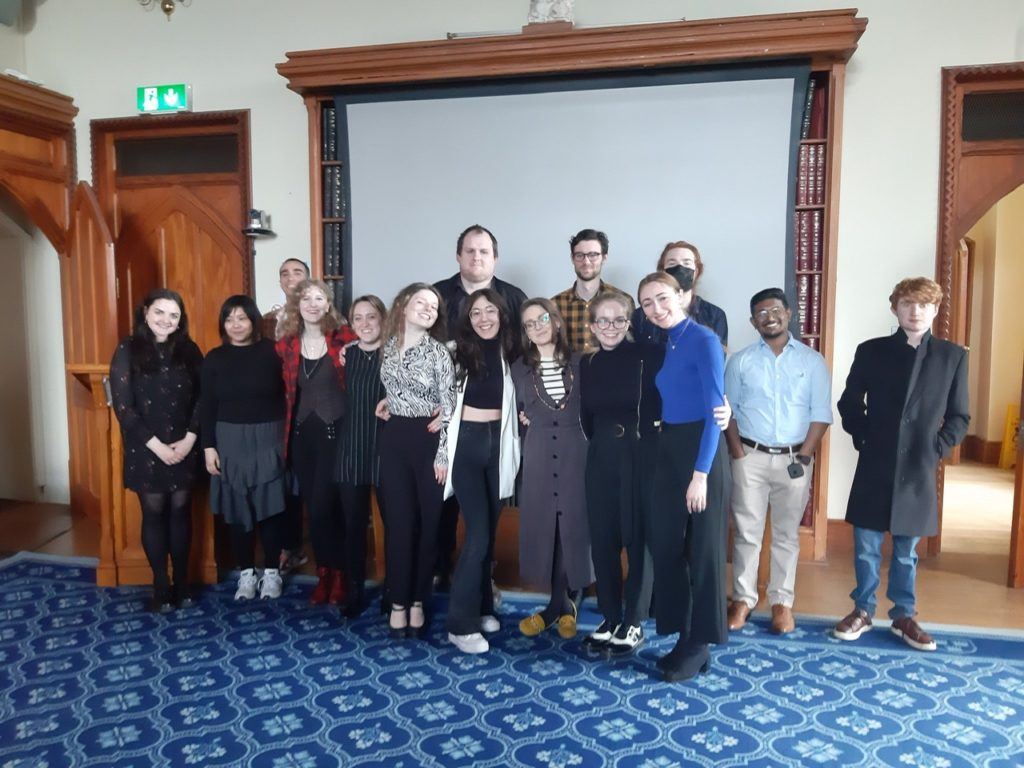
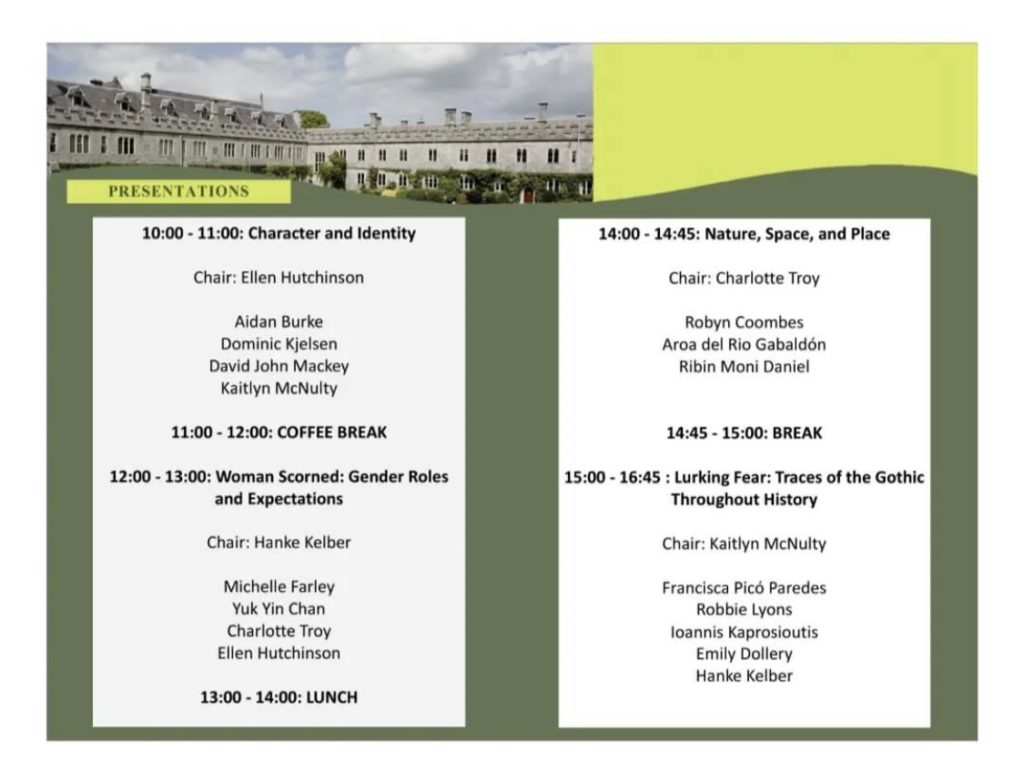
Thursday April 6th marked a big day for my fellow masters English Students and me – our own household, self-organised Mini-Conference.  

I had given myself extra duty by volunteering for work on the design committee and to chair a panel along with my research presentation. This choice was rewarding. The panel I had the honour of chairing considered Gender Roles and Expectation in media ranging from Chaucer’s Troilus and Criseyde to the work of Haruki Murakami. Following the general high standard of the conference content, the speakers delivered fascinating and entertaining presentations. Despite a challenge in the form of an online speaker, the panel went smoothly. The Question-and-Answer section was especially enjoyable. It revealed different perspectives on the topics through discussion and challenged me to pay close attention and formulate questions when the audience lulled. I would venture to call this my personal highlight, were it not for the consistent quality of papers and discussions throughout the day.  

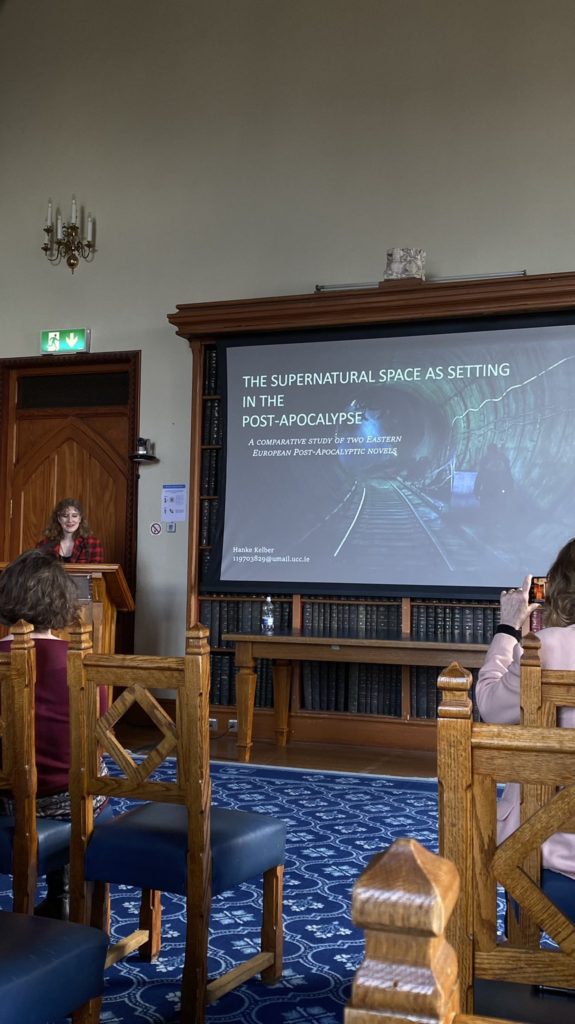
I anticipated my own paper with some nervosity, as I delivered the last presentation of the day. However, that position did not unsettle me too much. Confidence in my material and my previous foray into conference presentations proved useful in this case. The specific format of the presentation, a Pecha Kucha, initially was a source of dread and frustration. It required tricky timing and rhythm. Yet in the days leading up to the conference, it started to click. The format persuaded me of its benefits, its dance in between memorising a structure while improvising specific phrasings.

As a result, I was satisfied with the final presentation performance, despite a brief attack of nervosity towards its middle. The process transported me out of my comfort zone. It also helped me to refine my thesis research.  The question-and-answer section again provided a lot of enjoyment. Even though I am not personally satisfied with all the answers I gave, my excellent fellow speakers provided wonderful discussion.  

Ultimately, my personal performance only constitutes a part of what made the Textualities Conference rewarding for me. There was a community in sharing in my fellow students’ research, hearing them speak about what they are passionate. The conference’s communal nature and light-hearted atmosphere revealed the warmest side of research.

SMI and ICTM Joint Postgraduate Conference: A Brief Travelogue

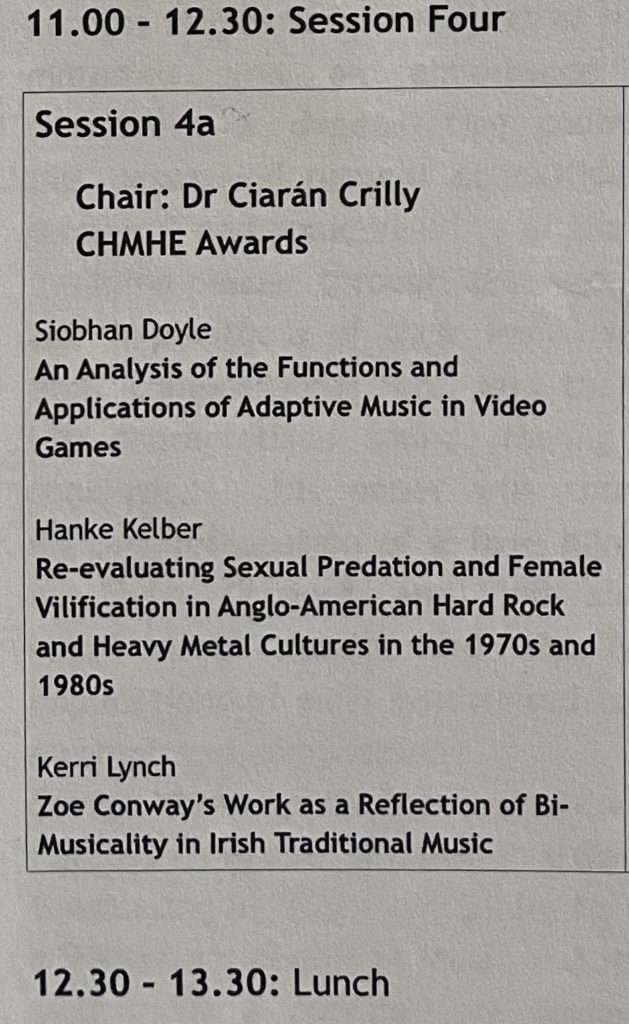
The weekend of January 21st and 22nd saw my first academic conference attendance. An exciting, slightly terrifying, but ultimately very rewarding experience. The Society of Musicology Ireland and the International Council for Traditional Music Ireland jointly hosted this Postgraduate Conference in University College Dublin, on the 21st and 22nd January 2023.

 I had the pleasure of presenting a paper based on my undergraduate thesis, which investigates issues of gender and sexual predation in Heavy Metal Music Cultures.  The opportunity to present accompanied an award by the Council Heads of Higher Music Education, which focuses on Irish Undergraduate Thesis in Music. As a consequence, the panel to which I contributed featured diverse topics.

Though my paper shed light on an intense and unsettling topic, it appeared to engage the attendees of the panel. Part of its appeal was distinctness among the conference, as it was one of few Popular Musicology Papers, contrasted with papers analysing Art Music, Traditional Music, or Ethnomusicology. As a result, the post-presentation questions revealed interesting discussion, some of which proceeded into the following break. The process of discussing the topic and conclusions of my thesis gave me the feeling of a firm knowledge in an area I had spent a considerable amount of time researching. There was something affirming in having my comparative expertise tested in such a way. I found myself excited to embark on the journey to acquire a similar knowledge through my Master’s thesis.  Yet, as big a role as my own presentation played for my conference experience, the panels and speakers were equally remarkable.

I attended a variety of panels with a diversity of papers. A common theme revealed itself across some papers and the keynote address. In a world peopled with increasingly advancing technologies, we are faced with more and more opportunities to marry artistic practice with technology. The distinction between traditions and forms, practices and mediums dissolve and blur.

A panel on Compositional Studies broached this theme. Yue Song, a composer and postgraduate researcher at TU Dublin Conservatoire, presented a fascinating paper. She discussed her compositional method in a project, which focuses on pieces for bass clarinet, enhanced by digitally created sound effects. To trigger the effects in live performance, the musician utilises a sensor triggered by a few natural movements and cues. With sensors more advanced and finely tuned than traditional live effect technology (such as guitar pedals), the project suggested an advanced synthesising of technology with artistic practice.

Picking up the goal of synthesis in a different context, Daniel Vives-Lynch of Trinity College pondered the problem of synthesising European Art Music with Irish Traditional Music. His concern lied with a true synthesis, rather than a “cultural colonisation” in the way of interpolating surface elements of traditional music into Art pieces. Although the two papers were different in approach and topic, they share a similarity at the core. As artists have access to wider inspirations through the power and connectivity of the Internet, they have to consider how to respectfully blend these influences and traditions. Be it in regards to technology or genre (be it musical or literary), the blurring of forms requires careful consideration and intent.

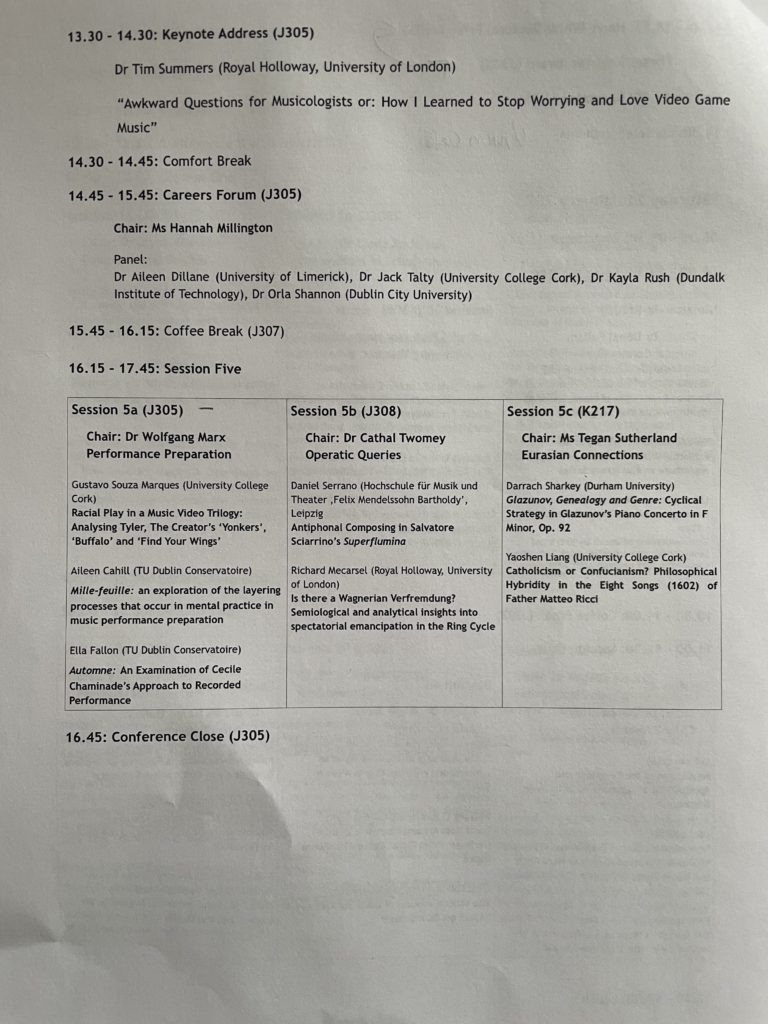
The Keynote address displayed a similar occupation with the broadening and change of mediums, from a critic’s perspective. Dr Tim Summers, University of London, delivered this engaging address, entitled “Awkward Questions for Musicologists or: how I learned to stop worrying and love Video game Music”. While focusing on Video Games in a Musicological context, Dr Summers confronted the audience with self-reflective questions suitable for any academic that approaches a comparatively new medium, like video games.

His questions encompassed both the material contexts to consider, such as the inherently subjective experience of a video game, as well as the traps of fallacious narratives. Strikingly, he referred to problems of authorial intent within a collaborative medium.

In the case of most video games, there are numerous agents working on music or narrative at any given point. Furthermore, there have been historically cases of marginalised composers not receiving credit or being credited under pseudonyms. This frequently leaves an uncertain space of authorship.

An increasing application of auteur theory to the medium of video games, as it becomes accepted as an art form, only furthers this problem. According to the address, the pitfalls of the auteur present one fallacy among many narratives. Dr Summers further disparages the construction of teleological narratives, narratives that conflate improvement with assimilation to more traditional forms. As an example, he critiques the idea that modern Video Game Scores have evolved in quality simply because they frequently resemble European Art music, unlike earlier 8-bit music. Critics may also have to consider the ideas and narratives they import by using terms and analytical tools conceived for other mediums.

Overall, this address delivered a challenge to anyone who dissects and analyses media, questioning the biases and assumptions we as critics bring to the table. As such, it was a highlight of the conference. Due to the thought-provoking ideas of the speakers and presenters, I did not only leave the conference with an academic achievement under my belt, but a reevaluated perspective and renewed passion for musicological and literary academia.

Defying the Edifice of linear History in Academic Research

This posts reflects on two research seminars held at University College Cork in November 2022. The first of the two took place November 2nd, delivered by Dr. Heather Laird and titled “Commemoration and Decolonisation – Reflections on the Centenary of 1922.” Dr. Michael G. Cronin presented the second, titled “Hopeful and Homoerotic Spaces in Irish Writing,” on November 16th.

For something that is ingrained into most human’s education and understanding of the world, the idea of history goes often unchallenged. In secondary education we will likely experience history in the format of neatly packed facts and narratives. These narratives will moreover emphasise agents and events of the political arena as the driving factor of a continually onwards movement. Educational curricula select which events were ostensibly the most important in shaping our present. History becomes about a selective cause and effect. My German secondary school’s curriculum of 20th century history drew a relatively direct narrative from Bismarck’s 19th century politics through the two World Wars to the present as the outcome of the influences and allegiances of the Cold War. As soon as any political agent’s role is concluded (e.g. German fascist or socialist movements), their name disappears from the history book.

Now, it is not my intention to deny that events of the past shape the present society in which we live. I also do not intent to imply that only the minority engage with history more complicatedly than their foundational education. I myself refigured my attitudes about history immensely after interacting with the subject at Third Level, being especially drawn to the way in which historiography is uncertain, biased, and subjective. I want to instead establish an example of the ways in which history is naturalised across society; as confined to certain agents and spheres, and to selected events of impact.  

Dr. Laird’s and Dr. Cronin’s Talks in University College Cork’s autumn research seminar series showed a fascinating commonality in suggesting different imaginings of historical temporality and influence. Heather Laird reflected upon ways of Decolonisation in which we can reflect on the future by looking towards events within the past that offered an alternative outcome. She discussed Agrarian Land Unrest as an example of Anti-Colonial and Socialist Action that ran contrary to the form of Irish Nationalism that succeeded in informing our current society. Land Unrest in this argument became a vision of an event that could have resulted in a different, less property-focused Irish society. It is an example of a glimpse into different possibilities, disrupting a narrative that frames our contemporary society as the inevitable outcome of the historical events that preceded it and society generally likes to commemorate.

This is a thought-provoking argument. It disrupts this edifice of cause and effect discussed above, the linear construction of history commonly taught.

In comparison, Dr. Cronin’s talk was of a literary nature. He detailed his research into novels of the Irish Queer Movement emerging in the 1990s. In his case studies, homoeroticism served as a spectre of hope and possibility. Through style and narrative, texts provided ambiguous spaces of imagination; spaces in which the future can be rife with possibilities, as we disconnect from the neoliberal hegemonic values that have permeated our being.

Both talks then shared a fascinating and relevant commonality. The speakers through different approaches suggested a disruption from historical fixed narrative. Furthermore, this break from linear narrative serves as the instrumental tool in re-imagining and re-shaping our future. Such a thought feels extremely relevant. Being fed a linear narrative of progress within history for instance, in which oppressed minorities fought for their rights, gained them, and thus gained equality, falsely suggests progress as linear. Current events in countries such as the United States or Poland, as well as continued discrimination and systemic oppression, violently shatter this illusion. What is left is a need to re constitute an understanding of history that better accommodates struggle.

While discussing Orwell’s Keep the Aspidistras Flying in a previous blog post, I contemplated the concept of Capitalist Realism. This concept strikes me again as relevant. A fixed temporal imagining of history can make it easier to imagine the end of the world than to imagine the end of capitalism. One of the most common counterpoints to critiques of neoliberal capitalism is that it is the system which has survived and been favoured by historical events. In contrast, most alternative ways of organising society, be they communist, socialist, or anarchist, have failed. The hegemonic fixed historical knowledge can constrict and limit the mind’s imagination for alternatives, and what remains is despair. Applying the insights from the research seminars could pose an entirely different approach. A failed Socialist state could instead become a historical possibility that, instead of failing did not succeed, an insight into a different possible present. And queer or subcultural spaces could become ambiguous spaces, disruptions to temporality that allow for imagining alternative futures, bursting mental constriction.

I would not dare pretend that this is a moral call to action or easy task. Rather, it is a theoretical reflection. Nonetheless, I regard it as relevant and not coincidental that such a shared interested in disrupting and re configuring history would crop up in contemporary academic research. One could suggest that we live in a cultural moment in which we are ever more focused on our intellectual biases and limitations. Even when applied to specific topics, such concerns reflect a drive of awareness that can illuminate any topic, an awareness of the narratives in which humans are embedded in society.