
The Uncomfortable Romance Of Role Playing Games

Love can be strange to represent in video games. Outside of dating simulators or other explicitly dedicated games, Role Playing Games (RPGs) such as Bethesda Studio’s iterations of the Elder Scrolls or the post-apocalyptic Fallout series, frequently offer the player choices for romance. As Bethesda is gearing up for the release of their new RPG, Starfield, I want to look closer at systems of romance in previous Bethesda games. Such an examination presents curious results. Romance systems can offer avenues to enjoyment and queer content. But at their core they can also tell us how people approach love in real life.

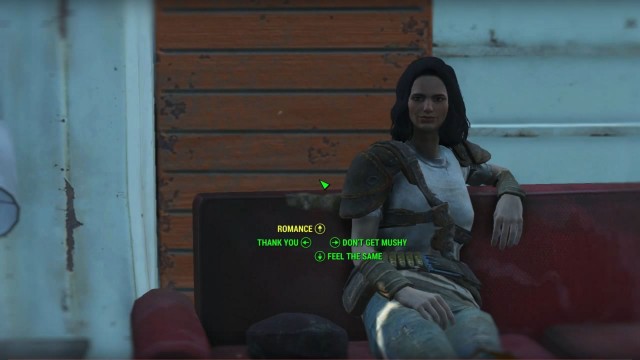
The Elder Scrolls V: Skyrim falls short in its options for romantic companionship. To marry in Skyrim, the player presents a specific artefact to their partner of choice. That spouse then benefits the player in transactional ways, often sharing goods and income. Useful, yes, but not much of a shot at depicting romance. One of Bethesda’s other games, Fallout 4, makes a more earnest effort. The player here can romance most (and any amount) of their companions through dialogue options. These options appear if the companion morally approves of the player’s actions, maximising the companion status. The relationship is then further enhanced through the completion of companion quests, which only surface when the companion trusts the player.

Artefact used for Romance in Skyrim

The result of the developed romance mainly consists of occasional romantic dialogue, and cheeky corner animations after sleeping. In a way, this brings us closer to actual love and romance at least; the player has to appeal to their companion through their actions and characterisation. As a result, such romances can be fun to achieve, especially for any players that wish to create queer content in their RPG experience, as all romance-able characters will be attracted to the player regardless of their gender.
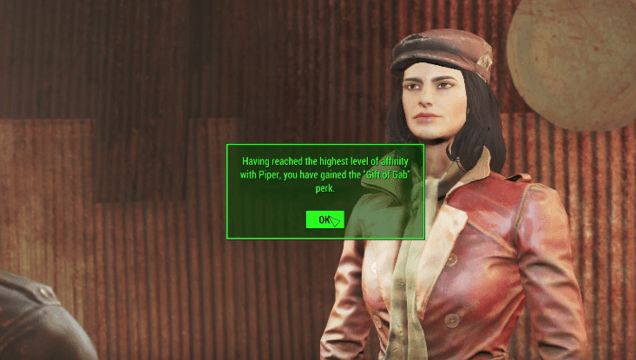
Relationship development boons in Fallout 4
Dialogue Option in Fallout 4

Yet, as enjoyable as using these mechanics can be, there is something inherently odd about them. Due to their optional nature, they never affect a player’s gaming experience significantly. Your companions in the end are still a transactional boon as far as the game is concerned. Everything else is left solely to the player’s imagination of a NPC(non-player character) with little dimension. The reality of their emotion and romance bears little depth to the characters and their world. It contributes to the feeling that the world of the game is made for you, the player. It revolves around you, its inhabitants ready to offer quests, be romanced, or shot.

To allude to the concept of the ‘Gay Button’, Romance mechanics are also not a satisfying definite inclusion of queerness, since only the player can initiate queer content. In contrast, I think RPGs without real romancing options can often be much stronger. Games such as Fallout: New Vegas or The Outer Worlds instead give their characters innate sexualities and identities that affect how they interact with the world around them. As a result, the game’s world feels more immersive. The world is made for the player, but it feels like it could exist on its own. That yields bigger benefit to me than creating a virtual romance thought experiment.

Philosophically, the idea of love as something you can achieve, with anyone, with the right kind of lines, resonates uncomfortably with modern dating discussions.

At its most harmless, it reminds me of the way people can talk about online-dating. There is this idea of making love logical, of having a set of lines that guarantees success. In dedicated communities, participants seem to attempt generalised advised about how profiles should look like, or what opening lines will guarantee success. The complexities of attraction and conversational dynamics become streamlined into over-promising codes and guides. This is not to say that anyone can be blamed for investing in this promise. Relationships are difficult, and it is natural to wish for a simpler narrative. But ultimately, they are still oversimplified narratives.

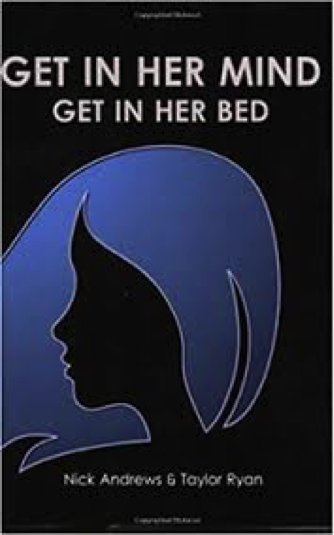
A parallel at its worst, the ideology of Pick Up Artists treats women like an RPG Romance system treats NPCs. They are not given interiority, but reduced to calculable responses and behaviours. It is not uncommon to hear about women’s “programming” by such people. They predict the outcome of certain dialogue lines and ‘openers’ or actions in their ‘game’, not giving much regard to the object of their desire.
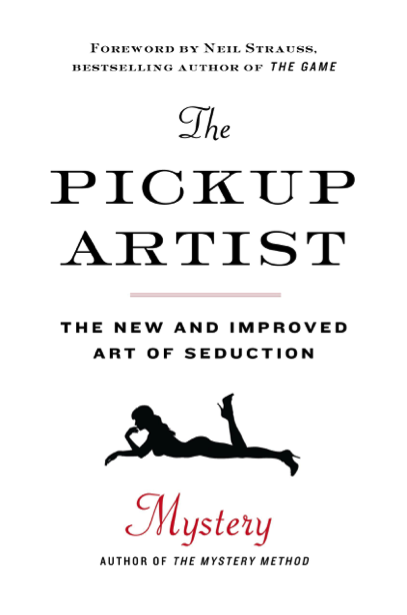
But what is the point of such an abstract discussion of a mere fun game mechanic? Well, maybe games replicate life a lot more than we think. Maybe games with one-note Romance systems are not as fun as thoughtful characters because they replicate something that does not help love in real life either. If the media we consume shapes how we interact with the world and people around us, it bears thinking about what fantasies about romance our media sells to us. Love and Romance is complicated, but much more successful when we respect our partners’ feelings and interiority. The temptation to retreat into simpler, classifying narratives provides little benefit. The more depth we allow for, the more we can make out of relationships.

SMI and ICTM Joint Postgraduate Conference: A Brief Travelogue

The weekend of January 21st and 22nd saw my first academic conference attendance. An exciting, slightly terrifying, but ultimately very rewarding experience. The Society of Musicology Ireland and the International Council for Traditional Music Ireland jointly hosted this Postgraduate Conference in University College Dublin, on the 21st and 22nd January 2023.

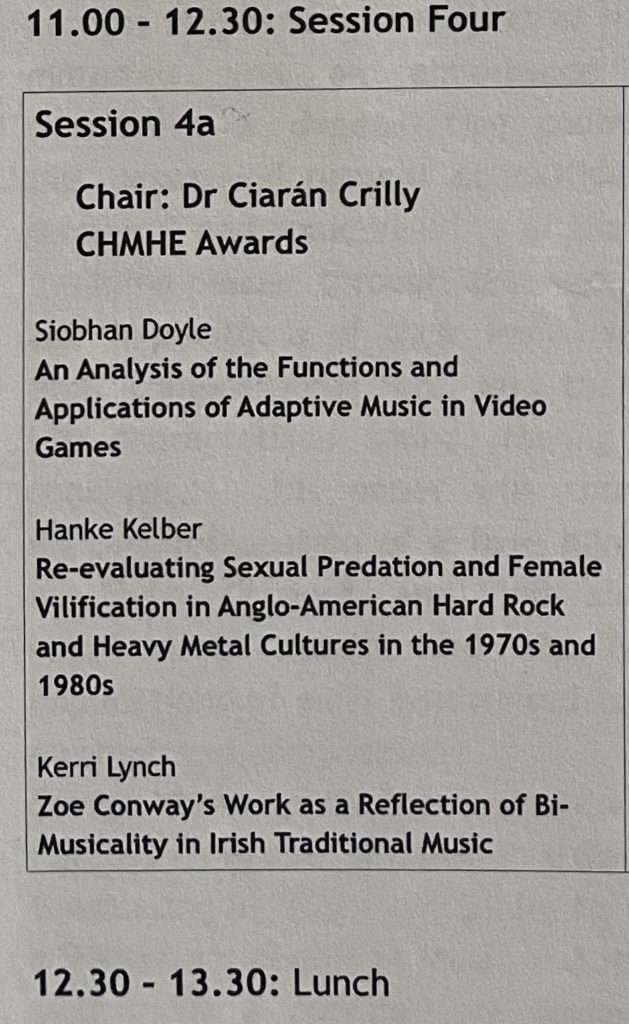
 I had the pleasure of presenting a paper based on my undergraduate thesis, which investigates issues of gender and sexual predation in Heavy Metal Music Cultures.  The opportunity to present accompanied an award by the Council Heads of Higher Music Education, which focuses on Irish Undergraduate Thesis in Music. As a consequence, the panel to which I contributed featured diverse topics.

Though my paper shed light on an intense and unsettling topic, it appeared to engage the attendees of the panel. Part of its appeal was distinctness among the conference, as it was one of few Popular Musicology Papers, contrasted with papers analysing Art Music, Traditional Music, or Ethnomusicology. As a result, the post-presentation questions revealed interesting discussion, some of which proceeded into the following break. The process of discussing the topic and conclusions of my thesis gave me the feeling of a firm knowledge in an area I had spent a considerable amount of time researching. There was something affirming in having my comparative expertise tested in such a way. I found myself excited to embark on the journey to acquire a similar knowledge through my Master’s thesis.  Yet, as big a role as my own presentation played for my conference experience, the panels and speakers were equally remarkable.

I attended a variety of panels with a diversity of papers. A common theme revealed itself across some papers and the keynote address. In a world peopled with increasingly advancing technologies, we are faced with more and more opportunities to marry artistic practice with technology. The distinction between traditions and forms, practices and mediums dissolve and blur.

A panel on Compositional Studies broached this theme. Yue Song, a composer and postgraduate researcher at TU Dublin Conservatoire, presented a fascinating paper. She discussed her compositional method in a project, which focuses on pieces for bass clarinet, enhanced by digitally created sound effects. To trigger the effects in live performance, the musician utilises a sensor triggered by a few natural movements and cues. With sensors more advanced and finely tuned than traditional live effect technology (such as guitar pedals), the project suggested an advanced synthesising of technology with artistic practice.

Picking up the goal of synthesis in a different context, Daniel Vives-Lynch of Trinity College pondered the problem of synthesising European Art Music with Irish Traditional Music. His concern lied with a true synthesis, rather than a “cultural colonisation” in the way of interpolating surface elements of traditional music into Art pieces. Although the two papers were different in approach and topic, they share a similarity at the core. As artists have access to wider inspirations through the power and connectivity of the Internet, they have to consider how to respectfully blend these influences and traditions. Be it in regards to technology or genre (be it musical or literary), the blurring of forms requires careful consideration and intent.

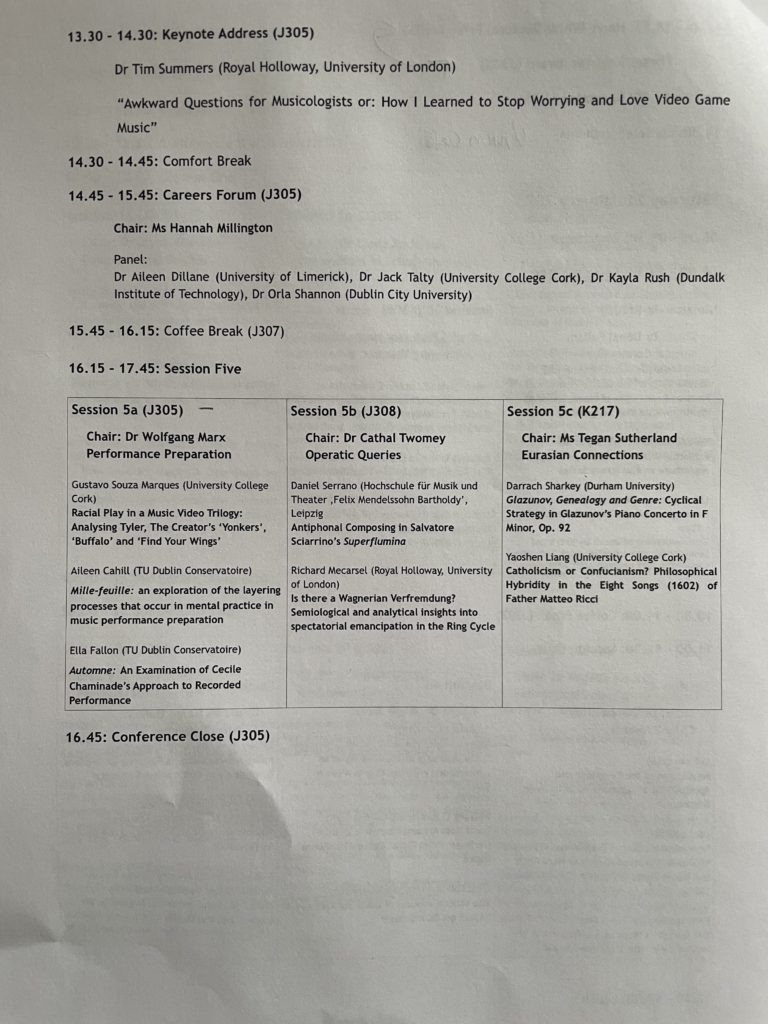
The Keynote address displayed a similar occupation with the broadening and change of mediums, from a critic’s perspective. Dr Tim Summers, University of London, delivered this engaging address, entitled “Awkward Questions for Musicologists or: how I learned to stop worrying and love Video game Music”. While focusing on Video Games in a Musicological context, Dr Summers confronted the audience with self-reflective questions suitable for any academic that approaches a comparatively new medium, like video games.

His questions encompassed both the material contexts to consider, such as the inherently subjective experience of a video game, as well as the traps of fallacious narratives. Strikingly, he referred to problems of authorial intent within a collaborative medium.

In the case of most video games, there are numerous agents working on music or narrative at any given point. Furthermore, there have been historically cases of marginalised composers not receiving credit or being credited under pseudonyms. This frequently leaves an uncertain space of authorship.

An increasing application of auteur theory to the medium of video games, as it becomes accepted as an art form, only furthers this problem. According to the address, the pitfalls of the auteur present one fallacy among many narratives. Dr Summers further disparages the construction of teleological narratives, narratives that conflate improvement with assimilation to more traditional forms. As an example, he critiques the idea that modern Video Game Scores have evolved in quality simply because they frequently resemble European Art music, unlike earlier 8-bit music. Critics may also have to consider the ideas and narratives they import by using terms and analytical tools conceived for other mediums.

Overall, this address delivered a challenge to anyone who dissects and analyses media, questioning the biases and assumptions we as critics bring to the table. As such, it was a highlight of the conference. Due to the thought-provoking ideas of the speakers and presenters, I did not only leave the conference with an academic achievement under my belt, but a reevaluated perspective and renewed passion for musicological and literary academia.