

“Make your Statement, face your Fear”
As of late, I have been revisiting one of my favourite podcasts, The Magnus Archives. Re-experiencing a piece of media always presents an interesting perspective. In this case, I found my attention drawn to how this particular story works, the ways it constructs its horror. Horror especially is an interesting genre for this kind of reflection. Similarly to Science Fiction or Fantasy, there are personas who’s DNA can be traced in most new additions. The Magnus Archives possesses a truly noteworthy relationship to one of the titans of horror: HP Lovecraft.
However, first I ought to provide context. The Magnus Archives is a horror podcast published by Rusty Quill, written largely by Jonathan Sims, directed by Alexander J Newall. It features a diverse cast, though Jonathan Sims voices the majority of episodes as the self-titled Head Archivist of the Magnus Institute.
The podcast revolves around the Magnus Institute in London, a paranormal research institution. A typical episode features a ‘statement’, a personal tale of paranormal occurrence, given to the Archives, surrounded by a larger story via pre- and post-Statement segments.
Jonathan ‘John’ Sims has recently taken over the position of Head Archivist. He initially seeks to record Statements with the goal of organising the chaotic Archives, left behind after the death of his precursor. Throughout 4 seasons of the podcast, John and his colleagues become increasingly embroiled into the mysterious events of their work, learning about and being marked by the powers lurking behind their world. The final season deals with the apocalyptic world that results from a multi-season arc.
The Magnus Archives presents a dense, immersive world, full of rich lore. I could write an entirely separate post about the how the podcast utilises and integrates its format, as for example, everything we hear is recorded in-universe.
But, as promised, in this post I will examine the podcast’s relationship to Howard Phillips Lovecraft. HP Lovecraft’s reputation in horror is for unique existential horror.
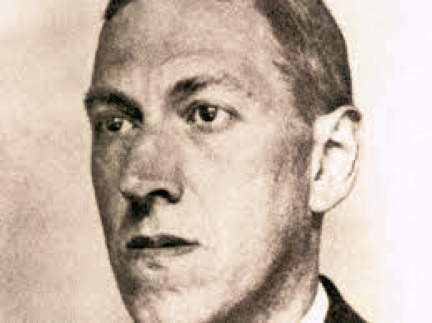
Lovecraft’s lore of the ‘Great Old Ones’ regards immensely powerful God-beings that lurk behind the curtain of reality, wishing to break into the world. The unimaginable cosmic horror of the Eldritch Gods lends Lovecraft’s work an unsettling horror of powerlessness in the world. The Magnus Archives invokes a similar concept. The powers that cause all paranormal events are ‘the Fears’, fourteen interconnected entities that are not truly a part of the story’s reality. Working through avatars and devotees, the Fears seek to breach the veil of reality, to feed on humans’ fear effortlessly. Those devoted to individual Fears treat them like Gods, and many of the Fears’ worshippers form cults. The podcast itself often speculates upon the Fears as gods, even if the characters clarify they are no concrete entities. Regardless, the connotation is inescapable: The Fears ultimately enter the story’s world through a Ritual and Incantation.
The kind of Horror that comes with their own eldritch entities resembles Lovecraft’s existential Horror. We can take John as a case study for this. John becomes corrupted and changed throughout the Podcast series, as agents of the Fears continually manipulate him. Even though he acquires knowledge about the world, he always remains two steps behind. He morphs into an agent of a Fear, the Eye, against his will; consequently he questions the extent of Free Will and power he has over his actions. Ultimately, he becomes the tool of causing the apocalypse against his will. John is merely one case study of the ways in which people are preyed on by powers out of their control, constructing a world in which individuals feel lost and powerless.
Yet the Magnus Archives also recognises that this kind of existential horror can feel analogous to the systematic exploitation, especially for marginalised people. The story’s cast features a lot of diversity. It is abundant in queer characters and characters coded to be of colour. The format of the statements, each given by different people, is able to cut across a vast section of society. Many statements invoke the exploitation and corruption of war, prejudice against immigrants, or police brutality. The horror of systems feels especially existential because all main characters come to realise they are unwilling participants and agents of the Fear’s predation. By implicating the characters within these predatory systems, the story conveys the horror of systems in which we are enmeshed but cannot escape.
Additionally, the Magnus Archives makes sure not to racially code its antagonists. Many of the cults, unlike Lovecraft’s mixed-racial Voodoo cults, read as Christian-like. When statements involve cursed locations, these travels involve Europe or North America, exposing a horror within.
The podcast shines here as a piece of media inspired by Lovecraft, by avoiding the pitfalls of Lovecraft. Because – to address the Elephant in the room – Lovecraft’s writings are famously profoundly racist. Yet, Lovecraft’s horror often still speaks to the existential feelings of horror marginalised outsiders can feel. (I will link an interesting video discussing this angle below). The Magnus Archives recognises the potential of Lovecraft’s horror and twists its interpretation to brilliantly fulfil a modern, engaging approach.
The Magnus Archives truly goes beyond in its apocalyptic vision. Unlike Lovecraft’s Old Ones, the Fears ultimately succeed. The world depicts what I would imagine as a Lovecraftian Apocalypse. Space and Time are suspended. The world functions differently in pockets across space. Death and human physical needs cease to exist. It is a world of nightmares, but since it is a logical extension of the previous story, the apocalyptic world heightens the horror of systematic exploitation. The Fears’ pockets construct loops and mini-ecosystems of fear that entrap humans in endless loops of fear and suffering.
It is difficult to execute Lovecraftian Horror well. It is certainly difficult not to inherit the problematic elements and tropes that permeate horror. The Magnus Archives executes an intelligent, medium-specific Lovecraftian Horror that elevates its inspirations. In this way, it is a horror story of modern sensitivity that I can only highly recommend.
Recommends and Sources
The Magnus Archives: https://open.spotify.com/show/5pwBAjuJJAOt7cED5Lkjnk
“Outsiders: How to Adapt H.P. Lovecraft In the 21st Century” : https://www.youtube.com/watch?v=l8u8wZ0WvxI
Images: – Original Podcast Logo and Current Podcast Logo: Soundcloud
– Picture of HP Lovecraft: Wikipedia